
January 20, 2026
What is rigging service? A rigging service is the planning and hands-on work needed to lift, move, and place heavy loads safely. These loads often include industrial machinery, structural steel, and oversized equipment. Rigging matters because a single mistake can damage equipment, shut down operations, or cause serious injuries.
This type of work is typically handled by experienced industrial contractors like Atlantic Millwrights, who support complex moves across manufacturing plants, warehouses, and construction sites throughout New England.
Key Summary
- Rigging services involve planning and executing the safe movement of heavy or oversized loads.
- Rigging is used for machinery installs, plant relocations, steel placement, and equipment removal.
- Safety depends on load calculations, proper gear, inspections, and clear lift plans.
- Rigging services often work alongside millwright, crane, trucking, and fabrication teams.
- Proper rigging projects require specialized equipment, trained personnel, and airtight planning.
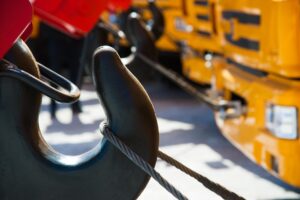
Rigging services explained in plain terms
A rigging service helps customers move heavy items that cannot be handled with basic tools or manual labor. “Heavy” does not only mean weight. It can also mean large dimensions, awkward shapes, fragile components, or tight site conditions.
Rigging usually includes three core parts.
- Planning the lift or move, including weight, balance, and travel path
- Selecting the correct equipment, such as slings, shackles, jacks, skates, or cranes
- Executing the move with controlled lifting and placement
Rigging is different from basic hauling or trucking. While trucking services may transport equipment between locations, rigging focuses on what happens on-site, lifting through doorways, rotating loads, setting equipment on foundations, and positioning components with precision.
Why rigging services exist, and why safety comes first
Industrial loads do not fail slowly. When something shifts or drops, the consequences are immediate.
According to the U.S. Bureau of Labor Statistics, there were 5,283 fatal work injuries in 2023. A significant portion of these incidents involved workers being struck by objects, including falling or suspended loads. This is exactly the type of risk rigging services are designed to control.
Rigging reduces risk by replacing guesswork with planning. Load weights are verified. Gear capacities are matched. Movement paths are cleared. Communication is defined before the lift begins.
Want more information about how Atlantic Millwrights can help you on your next rigging project? Contact us today for more information!

Common situations where customers need rigging services
Rigging services are typically needed when production equipment must move without disrupting operations. These are some of the most common scenarios.
Heavy machinery moving and installation
This includes presses, CNC machines, conveyors, compressors, and production lines. Rigging ensures the equipment is lifted, moved, and set accurately. This work often overlaps with millwright services, where machinery is aligned, anchored, and prepared for operation.
Structural steel rigging
Rigging is critical during industrial construction projects that involve beams, columns, and steel assemblies. Controlled lifts keep steel stable while crews position components safely at height.
Custom and complex rigging projects
Some loads are top-heavy, oversized, or located in tight spaces. These jobs often require custom solutions, including engineered pick points, gantry systems, or hydraulic jacking. In many cases, this work ties into custom fabrication and welding to support unique lifting needs.
What happens during a rigging job
While every project is different, most rigging jobs follow a consistent process.
Step 1: Identify the load and the goal
The team confirms the weight, dimensions, center of gravity, and final placement requirements. The goal may be installation, relocation, removal, or staging.
Step 2: Evaluate the site
Site conditions matter. Crews assess door clearances, floor capacity, overhead obstructions, and access points. This step prevents surprises during the lift.
Step 3: Select the rigging method and equipment
Depending on the project, this may include forklifts, gantries, hydraulic jacks, or crane services. The method is chosen based on safety, control, and efficiency.
Step 4: Create a lift plan
For higher-risk lifts, a formal plan outlines pick points, sling angles, communication signals, and load paths. This keeps everyone aligned before the move begins.
Step 5: Inspect and execute
Rigging gear is inspected, capacities are verified, and the lift is executed slowly and deliberately. Loads are guided into place, not rushed.
Want more information about how Atlantic Millwrights can help you on your next rigging project? Contact us today for more information!
Rigging safety basics customers should understand
You do not need rigging experience to recognize safe practices.
Gear inspection is not optional
OSHA requires that slings and rigging equipment be inspected daily before use. Any damaged gear must be removed from service immediately.
Sling angles affect real load forces
The angle of a sling changes how much force it carries. Even a correctly rated sling can fail if used at the wrong angle.
Standards guide safe rigging work
Most professional rigging programs follow OSHA regulations and reference ASME and CMAA standards to guide inspection, usage, and equipment design.
How rigging services support larger industrial projects
Rigging rarely stands alone. It often supports broader scopes of work.
Rigging is commonly coordinated with:
- Industrial Construction during equipment installs
- Industrial Demolition Services for safe equipment removal
- Warehouse Services for staging, storage, and logistics
This coordination helps reduce downtime and keeps projects moving without handoff delays.
What to ask before hiring a rigging company
Asking the right questions helps set expectations early.
- Have you handled similar equipment or site conditions?
- What equipment will be used, and what are its capacity limits?
- How will you protect floors, walls, and nearby assets?
- Will a lift plan be provided for complex moves?
Reviewing a contractor’s past projects and the industries they serve can also provide useful context.
Frequently Asked Questions
What is a rigging service?
Rigging service is the professional planning and execution of lifting, moving, and placing heavy loads using specialized equipment and trained crews.
Is rigging only used with cranes?
No. Rigging may involve cranes, forklifts, gantries, jacks, skates, or a combination of tools depending on the site and the load.
How does rigging differ from trucking?
Trucking moves equipment between locations. Rigging handles the controlled lifting and positioning of that equipment on-site.
When should a business use professional rigging services?
Any time equipment is too heavy, large, or complex to move safely with basic tools, professional rigging services should be used.
How do I get started with a rigging project?
The first step is discussing the load, site conditions, and schedule with an experienced contractor. You can contact us to review project details and determine the safest approach.